
The Ultimate Guide to B2B Newsletter Subscriber Growth for Tech Companies (2026)
Learn how B2B tech companies can grow qualified newsletter subscribers, improve engagement, and measure audience growth with meaningful metrics.

Key takeaways
- Effective B2B newsletter growth focuses on attracting qualified subscribers who match your Ideal Customer Profile, not simply increasing list size.
- Controlled circulation, confirmed subscribers, and engaged readers represent different stages of audience development and should be measured separately.
- Successful newsletter growth combines targeted distribution, voluntary opt-ins, and consistent editorial value.
- Metrics such as TAM coverage, subscriber conversion, and verified human engagement provide a more meaningful picture of newsletter performance.
Growing a B2B newsletter in 2026 is not about collecting as many email addresses as possible. It is about reaching the right buyers, converting them into confirmed subscribers, keeping them engaged, and connecting that audience to a commercial objective.
For B2B technology companies, that distinction matters. A large database is not necessarily an owned audience.
At OPTIN, the audience is better understood as a progression:
Target Market → Controlled Circulation → Confirmed Subscribers → Engaged Readers → Hand-Raisers
Each stage represents a different level of audience ownership and intent. Treating all of them as “subscribers” hides the information companies actually need to understand growth.
What does B2B newsletter subscriber growth actually mean?
B2B newsletter subscriber growth is the process of increasing the number of relevant people in your target market who deliberately choose to receive your newsletter and continue engaging with it.
The word relevant matters.
If you sell enterprise software to CFOs, adding thousands of unrelated contacts may increase list size without increasing commercial value.
A stronger framework is:
Effective Audience Growth = Target-Market Reach × Subscriber Conversion × Ongoing Engagement
That means a strong growth strategy must answer three questions:
- How much of the target market can we reach?
- How many of those people become confirmed subscribers?
- How many remain genuinely engaged?
What is the difference between circulation and subscribers?
Circulation and subscribers are not the same thing.
A circulation record is someone within the intended audience who can be reached through the newsletter distribution system.
A confirmed subscriber is someone who has explicitly chosen to receive the newsletter.
OPTIN separates the two through its Audience Ladder:
| Stage | Definition |
|---|---|
| Controlled Circulation | ICP-matched records reached through Selective Distribution™ |
| Confirmed Subscribers | Contacts who explicitly opt in |
| Engaged Readers | Readers generating verified human clicks |
| Hand-Raisers | People who reply or request further engagement |
Source: OPTIN proprietary Audience Ladder definitions.
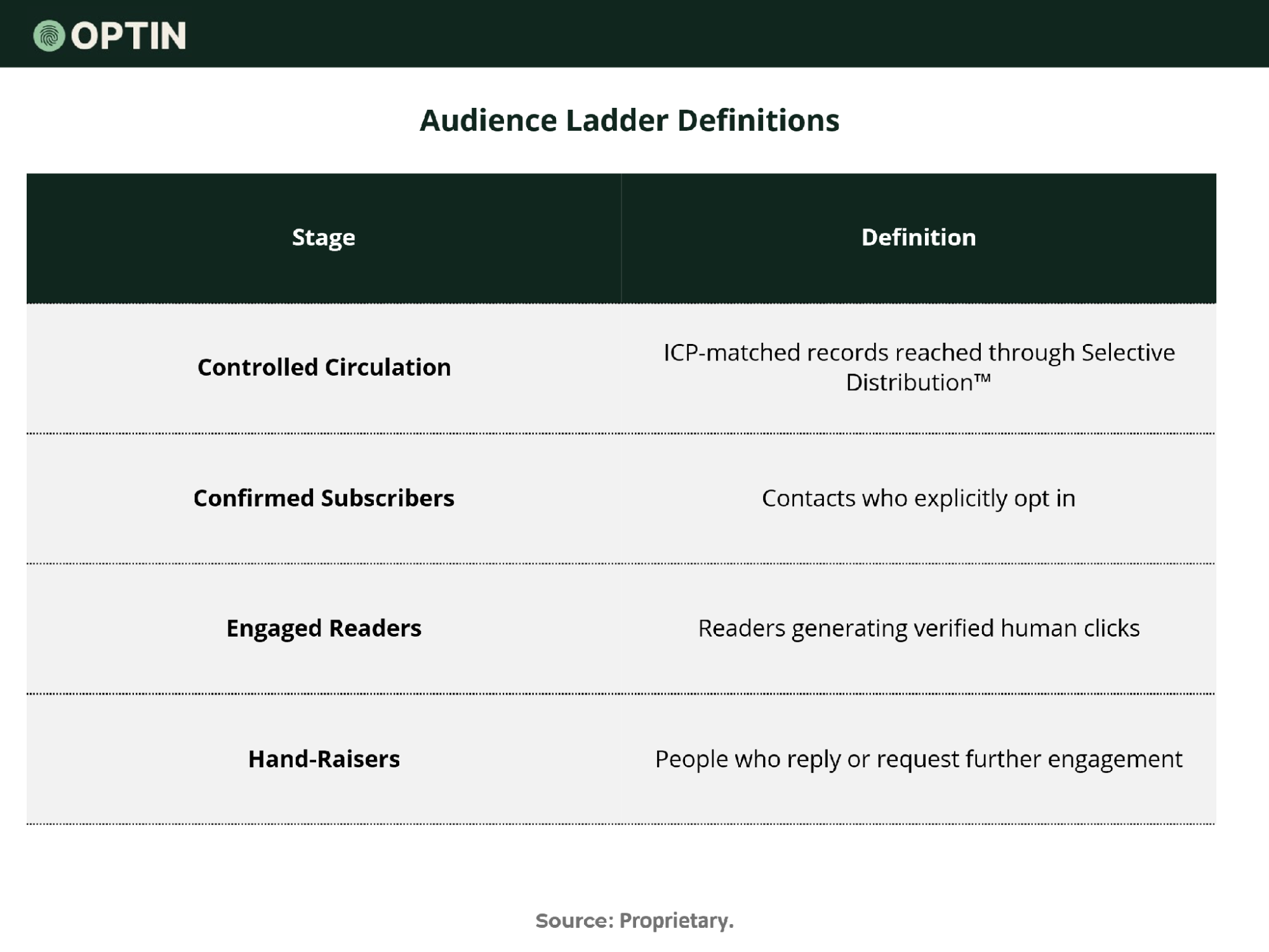
OPTIN reports confirmed opt-ins separately from circulation and uses bot-filtered human clicks rather than opens to assess engagement.
This makes the audience easier to evaluate honestly.
A company might have 50,000 people in circulation but only 15,000 confirmed subscribers. Calling all 50,000 “subscribers” would overstate the strength of the relationship.
How should a B2B tech company define its target newsletter audience?
Start with the customers you actually want more of.
The newsletter audience should be built around the company's ideal customer profile, using variables such as:
- Industry
- Company size
- Geography
- Seniority
- Function
- Relevant job titles
The resulting universe becomes the newsletter's Total Addressable Market, or TAM.
This creates a more useful metric than list size alone:
Newsletter TAM Coverage = Confirmed Subscribers ÷ Verified Target Audience
A newsletter with 20,000 subscribers inside a 60,000-person market may be strategically stronger than one with 100,000 subscribers spread across a much broader, less relevant audience.
Which growth strategies are most effective?
The strongest B2B newsletter growth strategies combine targeted distribution, subscriber conversion and consistent editorial value.
For most companies, that means four steps.
1. Define the audience
Know exactly who the newsletter is for and how large that market is.
2. Build qualified reach
Increase exposure among people who fit the ICP.
OPTIN calls this Selective Distribution™, which builds controlled circulation among ICP-matched contacts while keeping those records separate from confirmed subscribers.
3. Convert reach into subscribers
The next step is permission.
OPTIN uses Issue-as-Outreach™ as part of its subscriber-acquisition process, with contacts choosing whether to opt in and enter the confirmed subscriber file.
The important distinction is that outreach creates reach, while subscription remains voluntary.
4. Keep the audience engaged
Acquisition alone does not create an audience.
The newsletter must consistently give readers a reason to remain subscribed.
The growth loop is:
Reach → Value → Opt-In → Engagement → Commercial Relevance
Which metrics should B2B companies actually track?
The best newsletter dashboard separates audience size from audience quality.
At minimum, companies should track:
- Verified TAM
- Controlled circulation
- Confirmed subscribers
- Subscriber conversion rate
- TAM coverage
- Engaged readers
- Hand-raisers
- Cost per confirmed subscriber
This tells a much richer story than total list size.
For example:
Subscriber Conversion Rate = Confirmed Subscribers ÷ Qualified Reach
and
TAM Coverage = Confirmed Subscribers ÷ Verified TAM
These metrics show whether growth is happening inside the market that actually matters.
Why are open rates becoming less useful?
Open rates are increasingly imperfect measures of genuine attention.
Privacy tools and automated email activity can make it difficult to know whether an “open” represents a real person deliberately consuming the email.
For that reason, stronger engagement metrics include:
- Verified human clicks
- Replies
- Website sessions
- Downloads
- Demo requests
- Pipeline activity
OPTIN uses bot-filtered human clicks rather than opens when measuring engaged readers.
The principle is simple:
Measure human behavior, not just email events.
How can newsletter growth affect CAC?
A newsletter can reduce dependence on repeatedly paying third-party platforms to reach the same buyers.
In paid acquisition, reach often disappears when spend stops.
A confirmed subscriber relationship is different because the company has a permissioned channel through which it can continue communicating.
That does not mean newsletters are free. Companies still incur content, technology, acquisition and operating costs.
But the economics are different because the audience can compound over time.
That is the CAC argument for building an owned audience.
What should a B2B newsletter growth strategy look like in 2026?
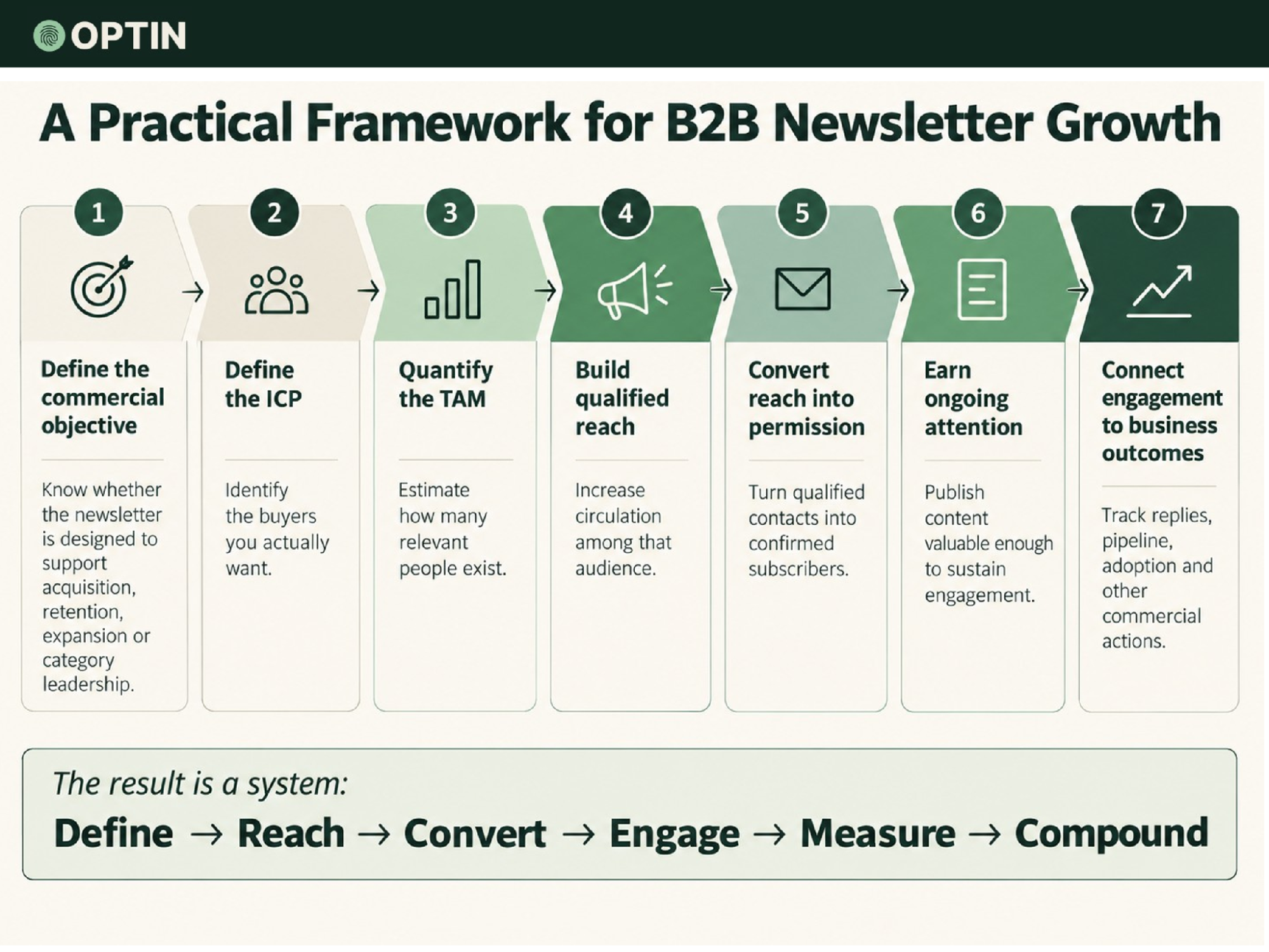
The practical framework in the original OPTIN article outlines seven steps:
- Define the commercial objective. Know whether the newsletter is designed to support acquisition, retention, expansion or category leadership.
- Define the ICP. Identify the buyers you actually want.
- Quantify the TAM. Estimate how many relevant people exist.
- Build qualified reach. Increase circulation among that audience.
- Convert reach into permission. Turn qualified contacts into confirmed subscribers.
- Earn ongoing attention. Publish content valuable enough to sustain engagement.
- Connect engagement to business outcomes. Track replies, pipeline, adoption and other commercial actions.
Define → Reach → Convert → Engage → Measure → Compound
Final Takeaway
The biggest mistake in B2B newsletter growth is treating email addresses, circulation, subscribers and engaged readers as the same thing.
They are not.
A strong newsletter growth strategy moves the right buyers through progressively stronger stages of relationship:
Reach them.
Earn the opt-in.
Keep their attention.
Create commercial relevance.
The objective is not simply to build a bigger list.
It is to own a larger share of the audience that matters.
Ready to grow your B2B newsletter? Learn how OPTIN helps technology companies reach qualified buyers and build an audience they own.
Frequently asked questions
What counts as a newsletter subscriber?
For measurement purposes, a subscriber should be someone who has explicitly chosen to receive the newsletter. OPTIN reports confirmed opt-ins separately from controlled circulation. (OPTIN)
Should newsletter growth focus on quantity or quality?
Both matter, but growth should happen inside the relevant target market. A smaller audience of actual buyers may be more valuable than a much larger but poorly targeted list.
What are the most important B2B newsletter metrics?
Track verified TAM, circulation, confirmed subscribers, conversion rate, TAM coverage, engagement and commercial actions.
How long does it take to build a meaningful B2B newsletter audience?
There is no universal timeline. Performance depends on TAM size, content quality, acquisition channels, infrastructure and investment.