
What to Look for in a Newsletter Growth Partner: A 12-Point Checklist
Use this 12-point checklist to evaluate B2B newsletter growth partners on subscriber quality, deliverability, reporting, business outcomes, and audience ownership.



Key takeaways
- The best newsletter growth partner prioritizes qualified subscribers who match your Ideal Customer Profile over simply increasing list size.
- Circulation, confirmed subscribers, engaged readers, and hand-raisers represent distinct stages of audience development and should be measured separately.
- A reliable partner should provide transparent acquisition methods, verifiable reporting, and infrastructure that protects email deliverability.
- Newsletter growth should connect to measurable business outcomes such as qualified conversations, pipeline, customer expansion, or retention.
- Clients should retain ownership of their confirmed subscriber audience, with full access to export their data when the engagement ends.
The best newsletter growth partner is not necessarily the vendor promising the most subscribers. It is the one that can clearly explain who it is targeting, where the audience comes from, what counts as a subscriber, how quality is measured, and who ultimately owns the relationship.
That distinction matters because "newsletter growth" can describe several very different things: expanding circulation, acquiring confirmed subscribers, increasing engagement, or generating commercial conversations.
Before hiring a partner, buyers should know exactly which one they are paying for.
Here is a 12-point checklist for evaluating a B2B newsletter growth partner.
1. Can they define your ICP and quantify your TAM before launch?
A strong growth partner should know who the newsletter is supposed to reach before trying to grow it.
Ask how the vendor defines the Ideal Customer Profile (ICP) and whether it can quantify the actual addressable audience by company, role, seniority, geography, and other relevant characteristics.
At OPTIN, the process starts with the client's closed-won customer base and a verified Total Addressable Market (TAM) study. Its current model requires a verified universe of at least 50,000 relevant contacts before setting Audience Ladder targets.
The principle is broader than that threshold:
If a vendor cannot define the market, it cannot tell you whether newsletter growth represents meaningful market penetration.
Ask: How many people actually fit our newsletter's target audience, and how did you calculate that number?
2. Can they explain exactly where the audience comes from?
"Subscriber acquisition" is not a channel.
A vendor should be able to explain which acquisition methods it uses, how each works, and what happens to a contact at every stage.
OPTIN publicly identifies two parts of its system:
- Selective Distribution™: Creates controlled circulation among ICP-matched contacts.
- Issue-as-Outreach™: Uses issue-led outreach to generate explicit opt-ins.
Whatever methodology a vendor uses, the buyer should be able to trace the path from:
Target Contact → Reach → Opt-In → Subscriber
Red flag: A vendor reports subscriber growth but cannot clearly explain where those subscribers originated.
3. Do they distinguish circulation from confirmed subscribers?
This may be the most important question on the list.
Someone who can receive your newsletter is not necessarily someone who has chosen to subscribe to it.
OPTIN separates these stages in its Audience Ladder:
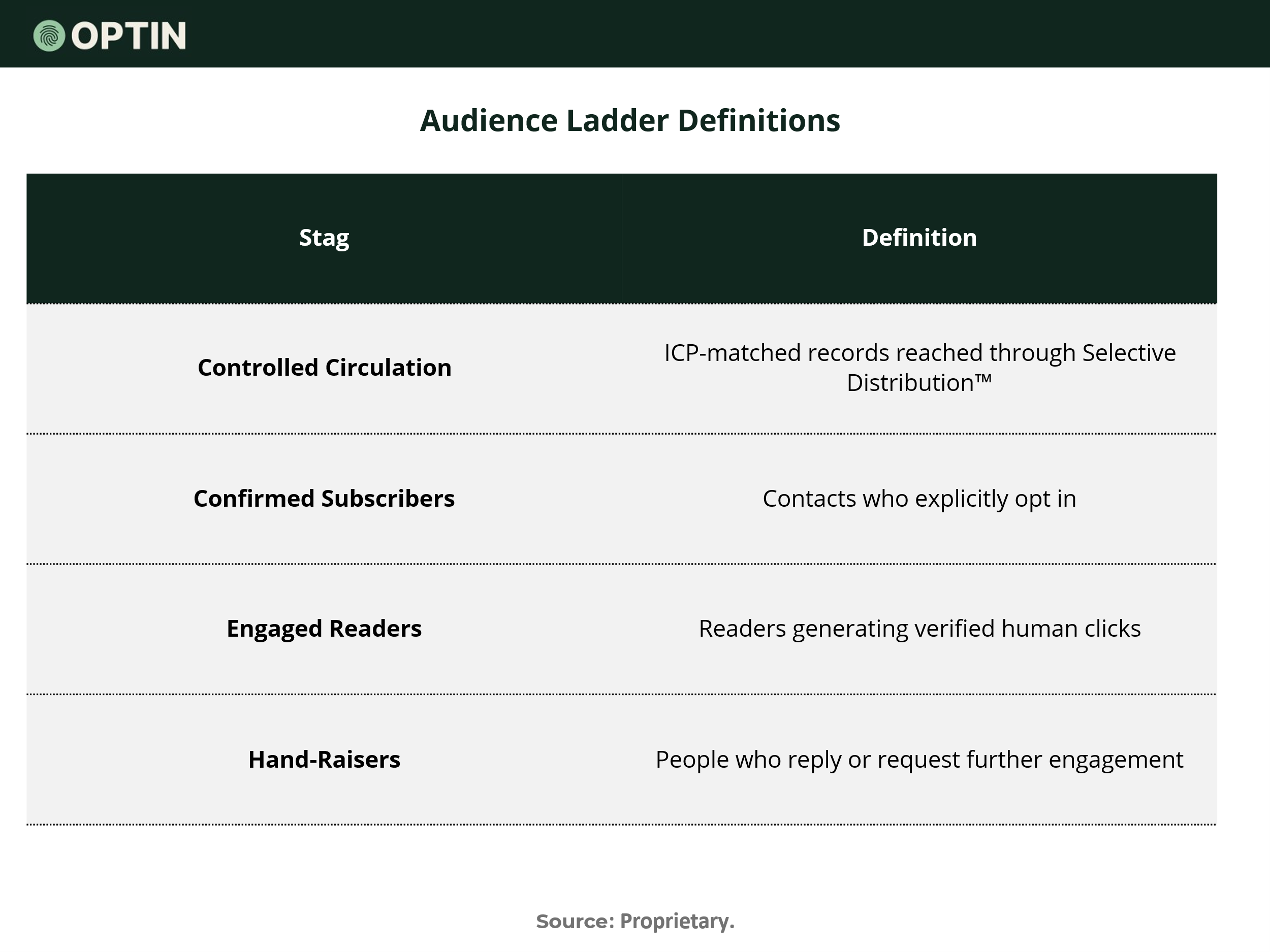
Source: OPTIN proprietary Audience Ladder definitions.
This prevents one large number from doing four different jobs.
Ask: When you say "subscriber," what exactly has that person done?
If the answer is unclear, the metric probably is too.
For a deeper explanation of these audience stages, read The Ultimate Guide to B2B Newsletter Subscriber Growth for Tech Companies.
4. Can they prove subscriber quality, not just volume?
A list can grow while becoming commercially weaker.
A strong partner should therefore demonstrate whether subscribers actually match the target market.
OPTIN reports confirmed subscribers against the verified TAM using attributes such as title, seniority, and account. It separately defines engaged readers using bot-filtered human clicks within the trailing 90 days.
A buyer should expect similar transparency regardless of vendor.
Useful quality questions include:
- What percentage of subscribers match our ICP?
- Which accounts are represented?
- Which roles and seniority levels are subscribing?
- How many remain engaged?
- How much activity appears to be genuinely human?
Subscriber count without audience composition is an incomplete metric.
5. Do they control the acquisition infrastructure?
Newsletter growth is partly a marketing problem and partly an infrastructure problem.
Ask what the vendor actually owns or controls behind the scenes.
OPTIN describes its acquisition infrastructure as including isolated domains, IP pools, warm-up schedules, and suppression logic.
The client owns the confirmed audience; OPTIN retains the acquisition infrastructure it uses to create that audience.
The exact architecture will differ across providers, but the principle remains:
The vendor should be able to explain the machinery behind growth, not merely the campaign sitting on top of it.
6. Can they protect deliverability while scaling?
Aggressive acquisition can become destructive if it damages sender reputation or contaminates the core subscriber file.
A competent partner should therefore have a clear answer to questions about:
- Sending domains
- IP infrastructure
- Warm-up
- Bounce management
- Suppression
- Spam complaints
- Unsubscribes
- Separation between acquisition activity and the confirmed list
OPTIN keeps its acquisition infrastructure separate from the client's confirmed subscriber file.
Ask: How do you prevent growth activity from damaging the deliverability of the audience we already own?
A vague answer should be treated seriously.
7. Is reporting transparent enough to reproduce?
The strongest reporting does not require the buyer to trust proprietary definitions.
Metrics should be sufficiently clear that the client's own team, or its Email Service Provider (ESP), can validate them.
OPTIN uses four fixed Audience Ladder definitions and explicitly avoids using opens as its core engagement measure, relying instead on bot-filtered human clicks.
That reflects a useful general standard:
Every headline growth metric should have a precise definition and a reproducible source.
A buyer should know exactly how the vendor calculates circulation, subscribers, engagement, and downstream actions.
8. Can they show results with context?
Case studies are useful only when the units are clear.
"50,000 reached," "50,000 subscribers," and "50,000 engaged readers" are not interchangeable outcomes.
When evaluating case studies, ask for:
- Starting point
- Ending point
- Time period
- Audience definition
- Acquisition method
- Whether the figure represents circulation or confirmed subscribers
OPTIN publishes named client examples and allows prospects to request reference calls with named clients before signing.
The critical principle is:
Never evaluate a growth number without knowing what the number actually counts.
9. Do they treat content as part of the growth system?
Distribution can put a newsletter in front of the right people. It cannot make them want to keep reading.
A growth partner should therefore have a view on content quality and retention, even if it is not responsible for writing every issue.
OPTIN uses a seven-dimension editorial scoring system. When a publication scores below 35/50, its editors can take responsibility for producing the issue.
The broader lesson is that acquisition and content should reinforce each other:
Distribution creates the opportunity for attention; content earns the right to keep it.
Ask the vendor what happens after somebody subscribes.
10. Can they connect audience growth to a business outcome?
Subscriber growth should ultimately serve a business objective.
Depending on the company, that might be:
- Qualified conversations
- Pipeline
- Customer expansion
- Product adoption
- Retention
- Net Revenue Retention (NRR)
- Category leadership
OPTIN structures programs around a defined commercial number, such as NRR, expansion pipeline, or qualified conversations.
That is preferable to treating subscriber count as the end goal.
Ask: If our subscriber count doubles, how will we know whether the business is actually better off?
A serious partner should have an answer.
11. Are targets presented honestly?
Be skeptical of guaranteed audience outcomes.
Newsletter growth depends on the size and quality of the addressable market, content, positioning, deliverability, acquisition economics, and buyer behavior.
OPTIN explicitly describes pilot numbers as targets rather than guarantees.
That is a useful test for other vendors as well.
A partner should be willing to establish ambitious targets while clearly explaining what assumptions sit behind them.
Red flag: Guaranteed growth numbers without a transparent TAM analysis or methodology.
Pricing alignment is also important, but OPTIN's public material does not currently establish a broader position on whether retainers, performance pricing, per-subscriber pricing, or hybrid structures are preferable.
That should therefore be evaluated separately rather than treated as a settled rule.
12. Who owns the audience when the engagement ends?
The answer should be unambiguous.
The confirmed subscriber relationship is one of the most valuable assets being created, so the client should understand exactly where the data sits and what happens if the vendor relationship ends.
With OPTIN, confirmed subscribers live in the client's ESP on the client's domain, and the client can export the confirmed file in full at any time.
The client retains the file, panel roster, and relationships.
That creates a simple buyer test:
If you stopped working with the vendor tomorrow, would you still possess the audience you paid to build?
If the answer is no, understand exactly what you are buying.
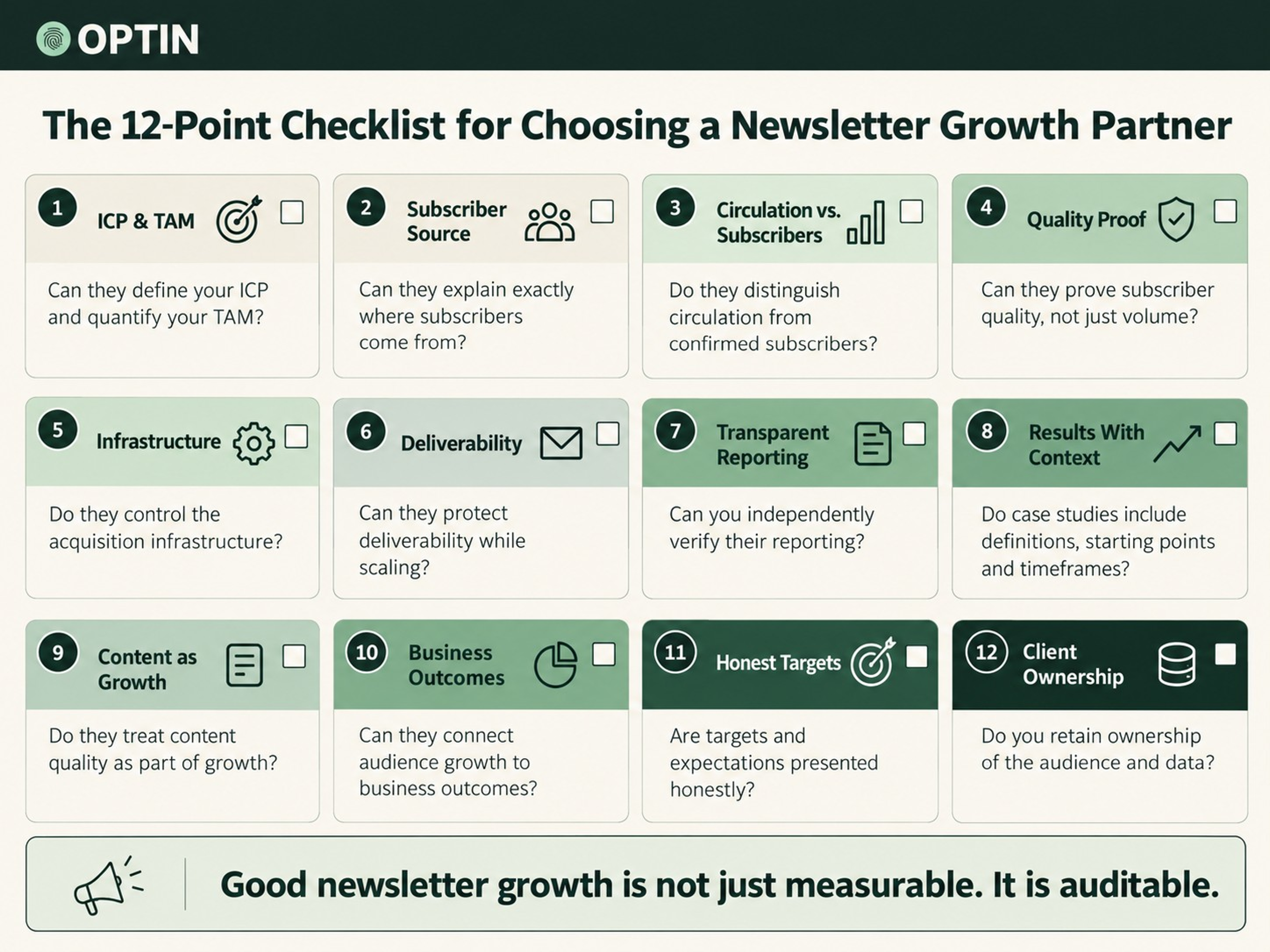
A vendor does not need to approach every one of these questions exactly as OPTIN does.
But it should have a clear answer to all twelve.
Final Takeaway
The easiest way to evaluate a newsletter growth partner is to look past the headline subscriber number.
Ask instead:
- Who are you targeting?
- How are you reaching them?
- What exactly counts as a subscriber?
- How do you prove they are the right people?
- What happens after they subscribe?
- And who owns the audience when you're done?
The strongest partner should be able to answer every one of those questions without hiding behind a dashboard.
Good newsletter growth is not just measurable. It is auditable.
Want to learn how OPTIN helps B2B technology companies build and measure an audience they own? Explore OPTIN's newsletter growth approach.
Frequently asked questions
What is the biggest red flag when choosing a newsletter growth partner?
The biggest red flag is ambiguous measurement, particularly when circulation, contacts, and confirmed subscribers are presented as though they were the same thing.
Should a newsletter growth agency guarantee subscriber numbers?
Guarantees should be treated cautiously because results depend on factors including TAM size, audience quality, content, and acquisition conditions. Clear targets based on explicit assumptions are more credible than unconditional guarantees.
Should the client own the subscriber list?
The buyer should establish this before signing. At OPTIN, confirmed subscribers remain in the client's ESP, and the confirmed file can be exported in full.
How should you evaluate subscriber quality?
Evaluate whether subscribers match the ICP by attributes such as account, title, and seniority, and then examine whether they demonstrate genuine human engagement over time.
Is subscriber growth enough to judge a newsletter partner?
No. Subscriber growth should be evaluated alongside audience fit, engagement, and the commercial outcome the newsletter exists to support.