
14 Tactics to Grow a B2B Newsletter With Your Exact Buyers
Explore 14 practical ways to grow a B2B newsletter by reaching ideal buyers, earning confirmed opt-ins, and measuring meaningful audience quality.


Key takeaways
- Effective B2B newsletter growth starts with defining an ideal customer profile based on existing customers and verifying the total addressable market.
- Qualified circulation and confirmed subscribers are different metrics and should be tracked separately to measure actual audience growth.
- Combining issue-based outreach, direct executive recruitment, LinkedIn distribution, and relevant podcast appearances can expand reach among target buyers.
- Editorial quality and consistent engagement are essential for building a valuable audience beyond initial subscriber acquisition.
- 1. Newsletter acquisition strategies should be evaluated using ICP match, confirmed opt-ins, verified human engagement, and relevant commercial outcomes.
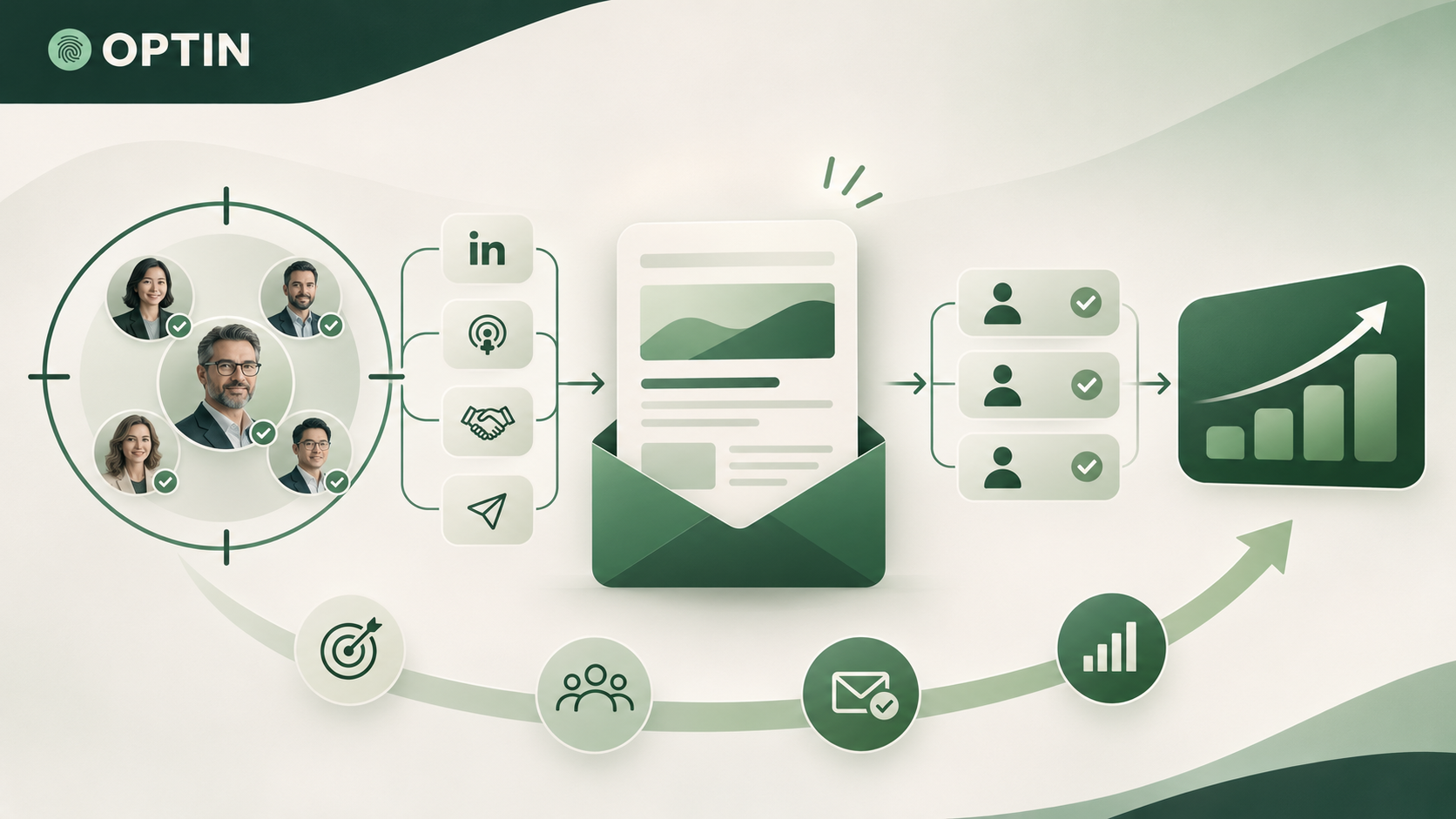
Growing a B2B newsletter is not simply about increasing the number of email addresses in your database. The goal is to reach the right decision-makers, convert them into confirmed subscribers, and build an audience that contributes to measurable business outcomes.
For B2B technology companies, audience relevance matters as much as audience size. A newsletter reaching 10,000 potential buyers can be more commercially valuable than one reaching 100,000 people with little connection to the company's ideal customer profile (ICP).
The strongest growth strategies therefore combine precise targeting, qualified distribution, voluntary subscriptions, and consistent engagement.
Here are 14 practical tactics for building a B2B newsletter audience that actually matters.
1. Build Your Target Audience From Existing Customers
The most effective starting point is your existing customer base. Rather than targeting broad categories like "technology professionals," examine your closed-won accounts to identify the industries, company sizes, roles, and seniority levels associated with successful customers.
At OPTIN, newsletter growth begins with defining the ICP from the client's closed-won base and verifying the addressable audience.
How to execute: Build a target-account list, identify relevant buying roles, and use those characteristics to guide every subsequent acquisition campaign.
2. Quantify Your Newsletter's Total Addressable Market
A newsletter needs a realistic growth ceiling. Understanding your Total Addressable Market (TAM) helps determine how many relevant people exist and how much of that audience your newsletter currently reaches.
For example, a company with 15,000 confirmed subscribers inside a verified market of 60,000 relevant buyers has achieved 25% subscriber TAM coverage.
Subscriber TAM Coverage = ICP-Matched Confirmed Subscribers ÷ Verified TAM
OPTIN requires a verified market of at least 50,000 contacts for its current growth model before establishing Audience Ladder targets.
How to execute: Estimate your relevant contact universe and measure subscriber penetration against it, rather than evaluating growth through list size alone.
3. Use Issue-Based Outreach to Acquire Subscribers
Traditional outreach often focuses on generating an immediate sales conversation. Issue-based outreach takes a different approach: it introduces prospects to editorial content and gives them the opportunity to subscribe.
OPTIN's Issue-as-Outreach™ methodology uses newsletter issues to reach people within the client's exact ICP, with double opt-in required for confirmed subscriber status.
This makes the publication itself part of the acquisition strategy.
How to execute: Build outreach around useful, buyer-relevant content, provide a clear invitation to subscribe, and distinguish outreach recipients from people who voluntarily confirm their subscription.
4. Build Qualified Circulation Before Measuring Subscriber Conversion
Not every person reached through newsletter distribution is a subscriber.
Controlled circulation expands exposure among qualified contacts, while confirmed subscribers are people who have explicitly opted in.
OPTIN's Selective Distribution™ builds ICP-matched circulation and reports it separately from confirmed subscribers. Its public materials report more than 2 million records placed through this methodology.
That distinction is essential: circulation creates reach, but it should never be presented as subscriber acquisition.
How to execute: Track qualified circulation, verified engagement, and confirmed subscriptions as separate metrics. If circulation generates opt-ins, measure that conversion explicitly rather than assuming it occurs.
For a deeper explanation of these audience-development stages, see The Ultimate Guide to B2B Newsletter Subscriber Growth.
5. Use Direct Outreach to Recruit High-Value Executives
Some of the most commercially valuable newsletter readers are difficult to acquire through broad digital campaigns.
Direct outreach, including phone-based recruitment, can help reach specific executives and establish explicit interest in a publication.
OPTIN uses phone opt-ins as a subscriber acquisition method and operates an Executive Panel™ that recruits named executives by phone.
How to execute: Identify priority executives within your ICP, communicate a clear editorial value proposition, and record their permission before adding them to the confirmed subscriber file.
6. Redistribute Newsletter Content on LinkedIn
Every newsletter issue can become an additional opportunity to reach buyers outside the existing email audience.
LinkedIn is particularly relevant for B2B companies because its professional networks create opportunities for content discovery among target accounts and decision-makers.
OPTIN's Subscriber-to-Network™ methodology redistributes newsletter content natively on LinkedIn.
How to execute: Adapt important insights from each issue into LinkedIn-native posts, maintain a clear connection to the newsletter, and provide interested readers with a straightforward way to subscribe.
The objective is not simply to generate impressions. It is to turn relevant exposure into a recurring relationship.
7. Use Podcast Appearances to Reach Relevant Audiences
Podcasts can introduce a newsletter to audiences that already have an interest in the subject matter.
A B2B cybersecurity newsletter, for example, could benefit from appearances on podcasts followed by security executives rather than pursuing general business audiences.
OPTIN describes Audience-to-Interview™, which involves podcast guest booking in both directions.
Podcast exposure should not automatically be counted as subscriber acquisition. Its contribution depends on whether listeners subsequently choose to subscribe.
How to execute: Identify podcasts whose audiences overlap with your ICP, participate in relevant discussions, and provide a clear newsletter subscription path.
8. Make Editorial Quality Part of Your Growth Strategy
Subscriber acquisition creates an opportunity for engagement, but content determines whether that relationship lasts.
A newsletter with weak or repetitive content can continually acquire subscribers while failing to build a meaningful audience.
OPTIN evaluates newsletter quality using a seven-dimension editorial scoring framework. Its operating model provides editorial intervention when a publication scores below 35 out of 50.
How to execute: Review each issue for relevance, originality, clarity, practical value, and reader engagement. Use the findings to improve future editions.
The principle is straightforward: distribution gets the newsletter noticed; content gives buyers a reason to stay.
9. Optimize Website Subscription Opportunities
General industry tactic. Not confirmed as an OPTIN-operated acquisition method.
A company's website already attracts potential customers who may be interested in its expertise but are not ready to purchase.
Newsletter subscription opportunities can convert some of that interest into a permissioned relationship.
How to execute: Place relevant subscription invitations on high-traffic pages, educational resources, and editorial content. Explain what readers will receive and why it matters.
Measure confirmed subscriptions rather than form submissions alone.
10. Build Referral Programs Around Existing Subscribers
General industry tactic.
Existing readers can help introduce a newsletter to people with similar professional interests.
For B2B publishers, the value of referrals depends on whether they generate relevant subscribers rather than simply additional contacts.
How to execute: Encourage forwarding, offer a simple subscription path for referred readers, and track whether new subscribers match the intended ICP.
Where appropriate, test referral incentives while keeping audience quality as the primary objective.
11. Partner With Complementary B2B Publications
General industry tactic.
Co-marketing partnerships can introduce a newsletter to an established audience without requiring a company to build every relationship from scratch.
For example, a revenue operations newsletter might collaborate with a publication serving B2B sales leaders.
How to execute: Identify complementary publications with overlapping audiences, test newsletter recommendations or content exchanges, and measure confirmed subscribers attributable to each partnership.
The strongest partnership is not necessarily the one with the biggest audience, but the one with the greatest overlap with your target buyers.
12. Convert Webinar and Event Audiences Into Subscribers
General industry tactic.
Webinars, conferences, and virtual events attract professionals interested in specific industry topics.
However, event registration should not automatically be treated as newsletter consent.
How to execute: Provide a distinct, voluntary newsletter subscription option during event registration and follow-up. Explain how future issues will extend the value of the event.
Track confirmed opt-ins separately from event attendance.
13. Activate Employees and Industry Experts as Distribution Channels
General industry tactic.
Executives, researchers, and subject-matter experts often have professional networks that overlap with the company's target market.
Their participation can help newsletter content reach buyers beyond the corporate account's existing followers.
How to execute: Give employees concise, useful insights from each issue that they can share through their own professional channels, with appropriate links to the newsletter.
Avoid turning employee distribution into repetitive promotional messaging. The content should provide value independently of the subscription invitation.
14. Measure Subscriber Quality and Optimize Acquisition Accordingly
Growth efforts should be evaluated by the quality of the audience acquired, not simply the number of contacts collected.
How to execute: Compare acquisition sources using ICP match, confirmed opt-ins, human engagement, and relevant commercial outcomes.
A channel producing fewer but more relevant subscribers may be more valuable than one generating substantially greater volume with weaker audience fit.
Which B2B Newsletter Growth Tactics Should You Prioritize?
Not every tactic is appropriate for every company. The right combination depends on the size of the target market, existing audience, available resources, and commercial objective.
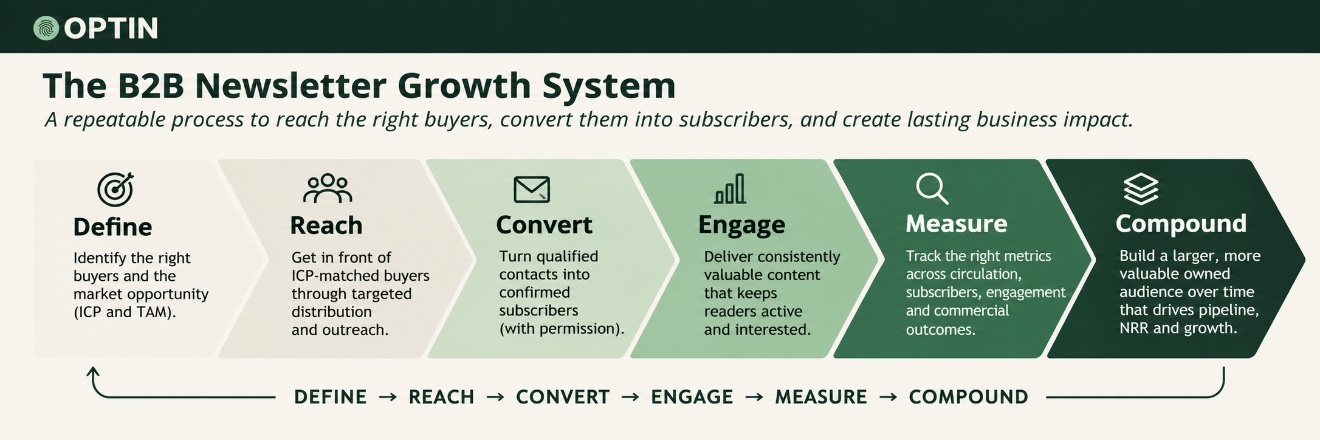
A practical approach is to organize the growth process into four stages:
| Stage | Primary Objective | Relevant Tactics |
|---|---|---|
| Define | Identify the right buyers | ICP analysis, TAM verification |
| Reach | Expand qualified exposure | Issue-based outreach, circulation, phone recruitment, LinkedIn, podcasts, partnerships |
| Convert | Earn voluntary subscriptions | Subscription forms, content offers, events, referrals |
| Engage & Measure | Build audience quality and commercial relevance | Editorial quality, engagement measurement, acquisition optimization |
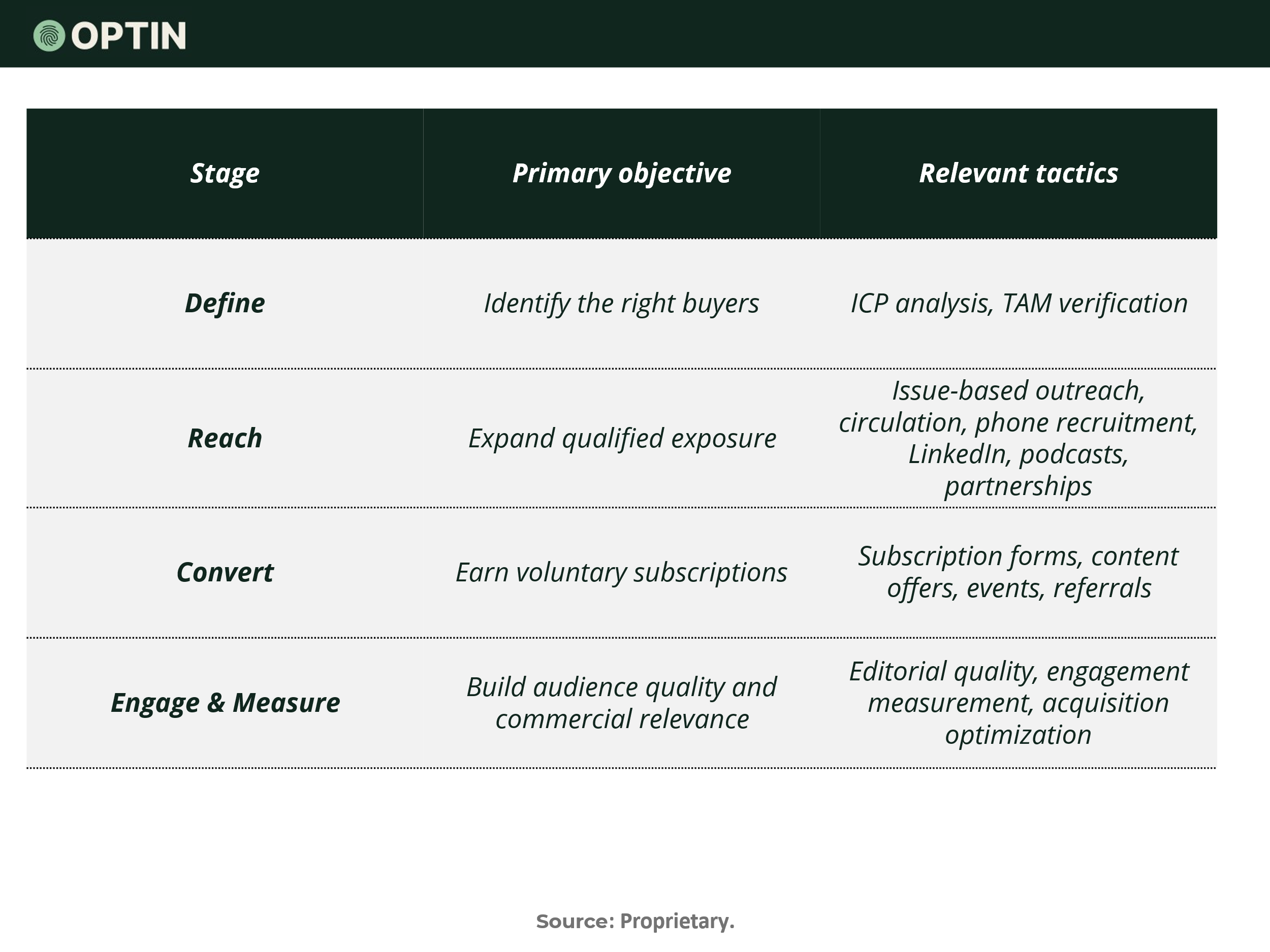
Source: Proprietary framework.
The goal is to build an acquisition system in which each channel serves a defined purpose.
Define → Reach → Convert → Engage → Measure → Compound
Final Takeaway
B2B newsletter growth is not about finding 14 ways to collect email addresses. It is about building a repeatable system for reaching the right buyers and developing stronger relationships with them over time.
The most effective strategies combine precise audience targeting, qualified distribution, voluntary subscription, valuable content, and transparent measurement.
The result is not simply a larger newsletter.
It is greater penetration of the market your business actually wants to serve.
Want to understand how OPTIN approaches qualified circulation, confirmed subscribers, and audience growth? Explore OPTIN's Audience Ladder.
Frequently asked questions
What is the best way to grow a B2B newsletter?
Start by defining your ideal customer profile and verified target market. Combine relevant distribution with clear subscription opportunities and consistently valuable content. Measure confirmed subscriber acquisition rather than raw contact growth.
How can I attract subscribers who match my exact ICP?
Use targeting criteria derived from your existing customers, including company characteristics, job titles, seniority, and industry. Evaluate new subscribers against those criteria to ensure audience relevance.
Does increasing newsletter circulation mean gaining subscribers?
No. Circulation measures qualified reach, while confirmed subscribers have explicitly chosen to receive the newsletter. These metrics should be tracked and reported separately.
Which newsletter acquisition channels are most effective?
Effectiveness depends on the target audience and execution. Compare channels using cost per ICP-matched confirmed subscriber, verified engagement, and downstream business outcomes rather than raw acquisition volume.
How should companies measure newsletter subscriber quality?
Evaluate how closely subscribers match the ideal customer profile, whether they demonstrate genuine human engagement, and whether that engagement contributes to meaningful commercial actions.