
Double Opt-In vs. Imported Lists: What Counts as a B2B Newsletter Subscriber?
Learn when imported contacts qualify as B2B newsletter subscribers, how double opt-in verifies consent, and which metrics separate reach from ownership.



Key takeaways
- An imported email contact is not automatically a newsletter subscriber. Subscription status depends on documented permission, not how the contact entered the database.
- Double opt-in adds a confirmation step that helps verify subscription intent and provides a more reliable record of permission.
- Newsletter circulation, confirmed subscribers, and engaged readers represent different audience relationships and should be measured separately.
- OPTIN's Audience Ladder distinguishes controlled circulation, confirmed subscribers, engaged readers, and hand-raisers to provide more transparent audience reporting.
- Subscriber TAM coverage and confirmed subscriber conversion rates help B2B companies evaluate audience development beyond total email list size.
A B2B newsletter with 100,000 email contacts does not necessarily have 100,000 subscribers. The distinction depends on how those contacts were acquired, whether they explicitly agreed to receive the newsletter, and how that permission is verified.
For B2B technology companies, confusing email circulation with confirmed subscriptions can overstate audience ownership, distort acquisition metrics, and make it harder to evaluate the commercial value of a newsletter.
The central distinction is straightforward: reach is not permission, and permission is not engagement.
Understanding the differences between imported contacts, double opt-ins, and verified subscribers is essential to building an audience that businesses can genuinely own.
What Actually Counts as a B2B Newsletter Subscriber?
A B2B newsletter subscriber is someone who has actively agreed to receive a recurring publication. For reporting purposes, the strongest standard is a documented, verifiable subscription event.
However, not every contact in a company's database meets that definition.
A business may have thousands of prospect records from CRM systems, events, outbound campaigns, or commercial data providers. Those contacts may be relevant to its ideal customer profile (ICP), but relevance does not automatically establish subscription consent.
This creates three distinct audience categories:
Reachable contacts: People whose contact information is available for potential communication, subject to applicable rules.
Consented subscribers: People who have explicitly agreed to receive the newsletter.
Engaged readers: Subscribers who demonstrate genuine interaction with its content.
These categories should be measured separately rather than combined into a single headline number.
What Is Double Opt-In, and Why Does It Matter?
Double opt-in is a subscription process in which a person first expresses interest in receiving emails and then completes an additional confirmation step, typically by clicking a link sent to their email address.
The process usually follows three stages:
Initial request: The reader enters an email address or requests a subscription.
Confirmation: The system sends a verification message requiring an additional action.
Verified subscription: The reader confirms, and the subscription is recorded.
This second step helps verify that the address is controlled by someone who intends to receive the newsletter.
According to HubSpot's documentation, double opt-in adds an additional confirmation step to verify subscriptions before marketing emails are sent.
Double opt-in is not universally required by law, and requirements depend on jurisdiction and circumstances. However, it can provide a clearer evidentiary basis for subscription status and reduce accidental signups.
For B2B companies investing in audience growth, the advantage is not simply compliance. It is greater confidence in what the subscriber count actually represents.
Do Imported Email Lists Count as Newsletter Subscribers?
Importing a contact does not automatically make that person a newsletter subscriber. Importing is a method of transferring data, not proof of consent.
An imported list may contain contacts who previously subscribed through another platform, existing customers with documented newsletter permission, prospects who never requested the newsletter, or records purchased from a third-party provider.
These situations should not be treated identically.
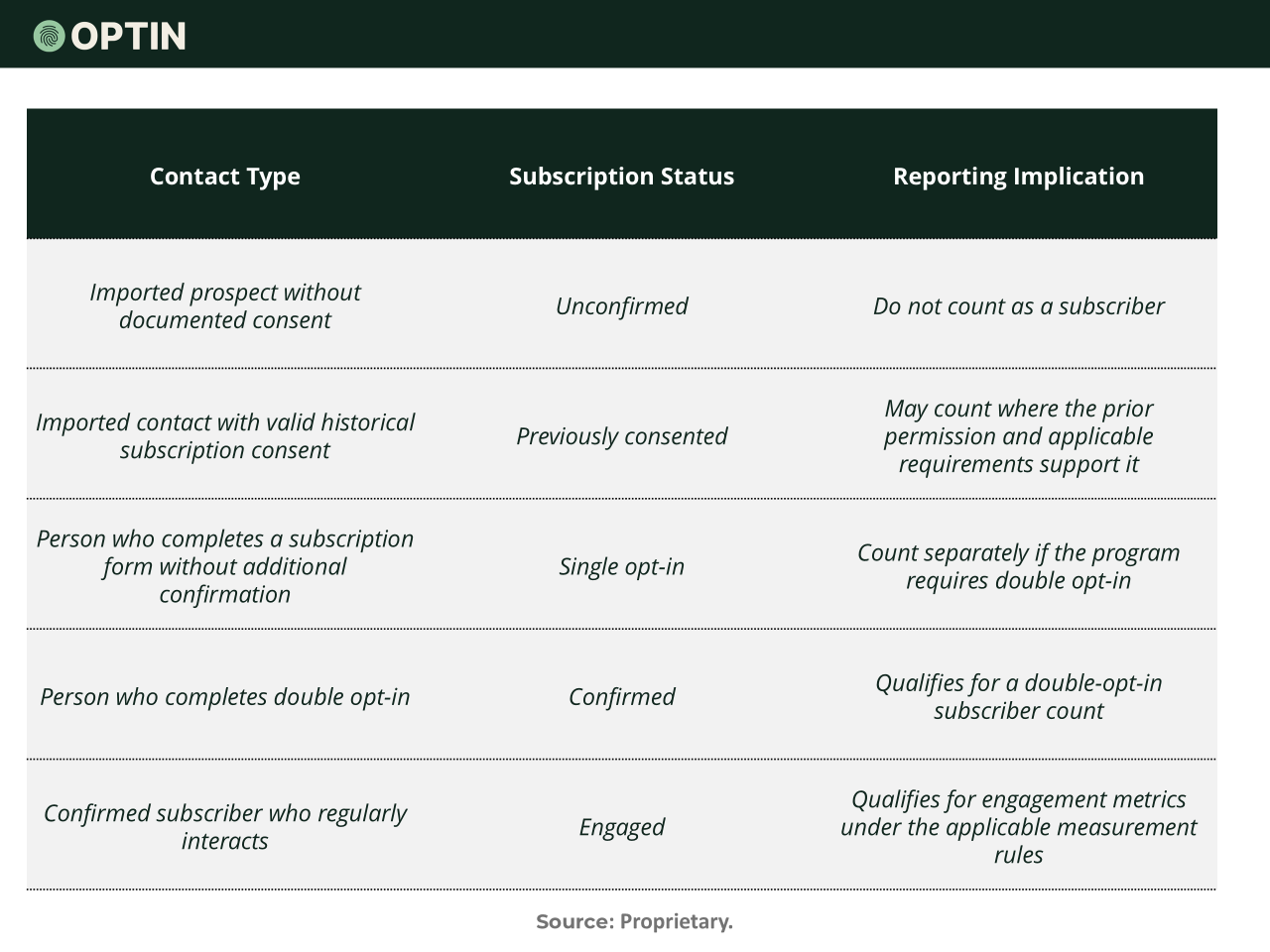
The distinction is also recognized by major email platforms. Mailchimp allows subscribed contacts to be imported when the sender has permission, while HubSpot provides confirmation workflows for imported contacts.
The important question is not whether a contact was imported.
It is whether the business can substantiate that person's permission to receive the newsletter.
What Is the Difference Between Newsletter Circulation and Confirmed Subscribers?
Newsletter circulation measures distribution or reach, while confirmed subscribers represent people who have actively completed the required subscription process.
A company may reach tens of thousands of relevant professionals through a distribution program without those professionals becoming confirmed subscribers.
For example, imagine a B2B software company with:
80,000 ICP-matched circulation records
20,000 confirmed subscribers
8,000 recently engaged readers
These are illustrative figures, not industry benchmarks.
The company should not claim to have 80,000 confirmed subscribers. It has 80,000 circulation records and 20,000 confirmed subscribers, with a smaller group demonstrating recent engagement.
This matters because different audience categories represent different levels of relationship and permission.
The distinction also prevents companies from presenting distribution growth as equivalent to subscriber acquisition.
How Does Optin's Audience Ladder Work?
Optin uses its proprietary Audience Ladder to distinguish four levels of B2B newsletter audience development.
Rather than combining every contact into a single subscriber figure, the methodology separates distribution, subscription, engagement, and commercial interest.
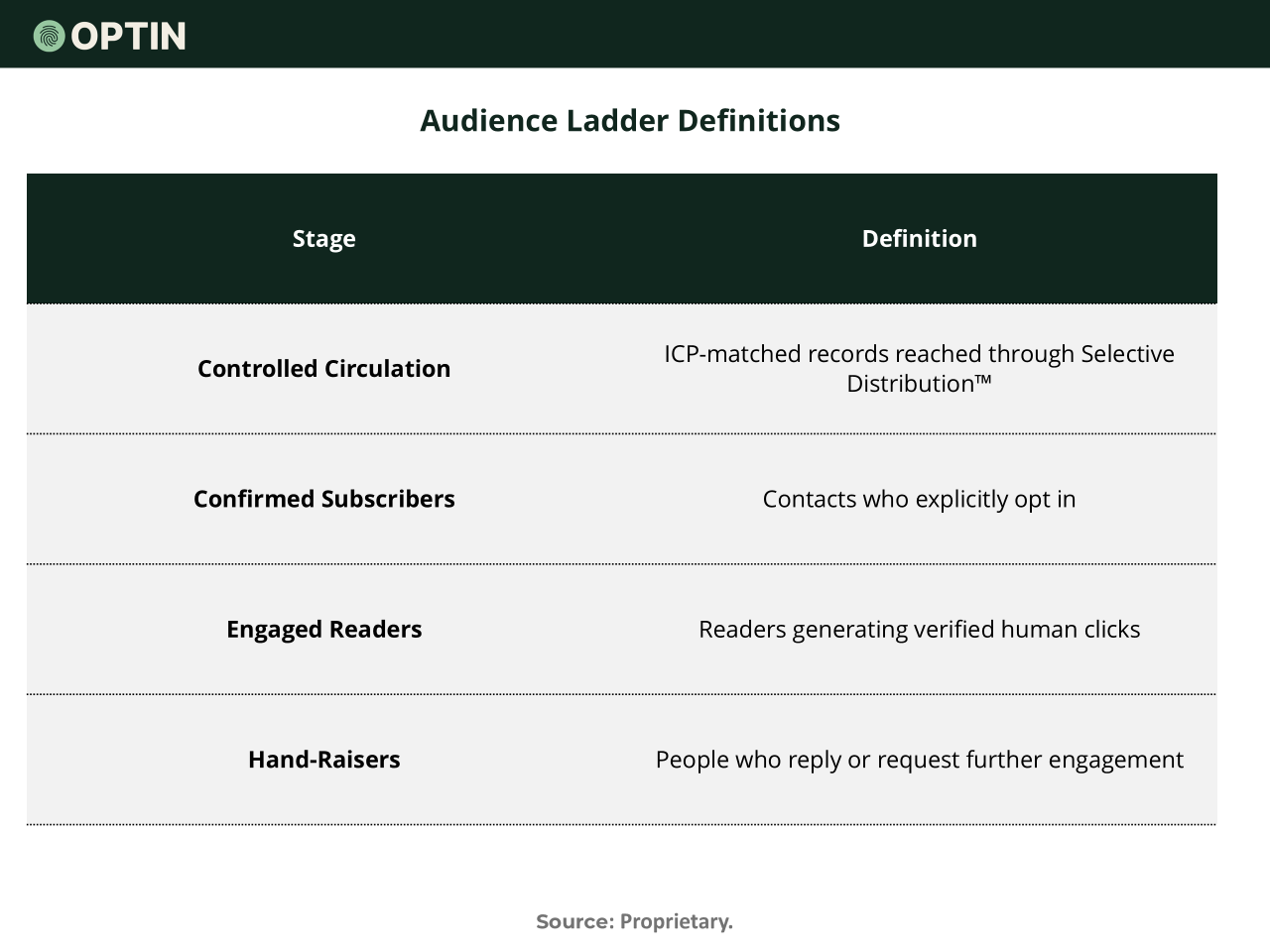
Under this framework, only confirmed opt-ins are reported as subscribers.
Optin's Selective Distribution™ expands controlled circulation among professionals matching the client's ICP. It does not automatically convert those contacts into subscribers.
Cold-to-Optin™, meanwhile, uses newsletter content to approach relevant professionals and acquire confirmed subscriptions through an explicit opt-in process.
Optin operates acquisition activity on proprietary infrastructure separate from the client's email service provider (ESP). Its published policy states that no contact enters the client's subscriber file without a confirmation record.
This provides a clearer separation between the audience a company can reach and the audience that has actively chosen to receive its newsletter.
Why Does Subscriber Verification Matter for B2B Companies?
Subscriber verification has implications beyond accurately reporting audience size.
First, it improves measurement. Companies can distinguish qualified distribution from actual subscription acquisition, making conversion rates and acquisition costs more meaningful.
Second, it supports audience quality. A verified subscriber file can be evaluated against the ICP using attributes such as company, title, seniority, and buying relevance.
Third, it strengthens audience ownership. A confirmed subscriber relationship gives the company a permissioned communication channel, rather than merely access to a database of potential recipients.
Fourth, it improves engagement analysis. Separating confirmed subscribers from engaged readers makes it easier to identify whether an audience is genuinely interacting with the publication.
These distinctions become particularly important when newsletter performance is connected to customer acquisition cost (CAC), pipeline development, or net revenue retention (NRR).
A larger contact database does not automatically improve any of those outcomes.
A verified, relevant, and engaged audience provides a more defensible foundation for measuring them.
How Should B2B Companies Measure Their Real Subscriber Base?
A useful newsletter measurement framework should separate five indicators:
1. Verified TAM: The number of relevant professionals within the defined addressable market.
2. Qualified circulation: The number of ICP-matched contacts reached through distribution.
3. Confirmed subscribers: The number of contacts with verifiable subscription permission meeting the program's confirmation standard.
4. Engaged readers: Subscribers demonstrating genuine human engagement during a defined period.
5. Commercial responses: Readers who reply, request information, or take other measurable actions relevant to business objectives.
Companies can then calculate:
Confirmed Subscriber Conversion Rate = New Confirmed Subscribers ÷ Qualified Contacts Reached
And:
Subscriber TAM Coverage = ICP-Matched Confirmed Subscribers ÷ Verified TAM
Both formulas require clearly defined populations and measurement periods. They should not mix cumulative lifetime reach with current subscriber counts.
For example, a business with 12,000 ICP-matched confirmed subscribers inside a verified TAM of 60,000 contacts has achieved 20% subscriber TAM coverage.
That metric provides a more useful perspective on audience development than absolute list size alone.
For more on newsletter audience strategy and measurement, see The Ultimate Guide to B2B Newsletter Subscriber Growth for Tech Companies.
Final Takeaway
The biggest mistake in B2B newsletter reporting is treating contacts, circulation, subscribers, and engaged readers as interchangeable metrics.
They represent different relationships.
Imported contacts may provide qualified reach. Documented consent establishes a subscription relationship. Double opt-in adds a verification step. Genuine engagement demonstrates continued interest.
For B2B technology companies, understanding these distinctions is essential to measuring audience quality and building an owned communication channel.
Optin's Audience Ladder formalizes that approach by separating controlled circulation, confirmed subscribers, engaged readers, and hand-raisers, giving businesses a clearer view of what their newsletter is actually building.
The objective is not to claim the largest audience. It is to build the largest verifiable audience of buyers who matter.
Want to build a verified B2B newsletter audience? Explore OPTIN's approach to subscriber growth.
Frequently asked questions
Is double opt-in required for B2B newsletters?
Not universally. Legal requirements vary by jurisdiction and circumstances. Double opt-in nevertheless provides a stronger confirmation record and can help companies maintain more reliable subscriber reporting.
Can imported contacts count as newsletter subscribers?
Yes, when they have valid, documented prior consent that covers the intended newsletter and satisfies applicable requirements. Importing contact information alone does not establish subscription permission.
What is the difference between a lead and a subscriber?
A lead is a contact with potential commercial relevance. A newsletter subscriber is someone who has agreed to receive the publication. A person can be both, but neither status automatically establishes the other.
Does double opt-in guarantee subscriber engagement?
No. Double opt-in verifies a subscription action, not sustained attention. Engagement must be measured separately through relevant human activity such as verified clicks and replies.
How does OPTIN count confirmed subscribers?
OPTIN distinguishes confirmed subscribers from controlled circulation and reports subscribers acquired through double opt-in via Cold-to-Optin™ or phone. The confirmed file remains in the client's ESP, with supporting confirmation records.